TurboTax AI-powered help
Bringing AI-powered help to tens of millions of tax filers before log in.
Role:
Lead Product Designer
Platform:
Responsive Web
Project Type:
New Feature
Deliverables:
UX Design, User Flows, Prototypes
Team:
Team Manager, Product Manager, Researcher, and Engineers
View Live Site:
ttlc.intuit.com
Summary
Challenge
TurboTax's help websites were losing organic traffic as Google's AI-generated search answers kept users from clicking through. Static keyword search couldn't compete, and the gap was hitting revenue targets.
Approach
I led all design work across two sequential A/B tests. A failed first test proved the hypothesis I drove into the second: the search bar itself needed to become the unified entry point to AI-powered assistance.
Results
4% improvement over control
Context / Background
TurboTax's Support Site and Community are where millions of users go before they ever open the product, to get answers, compare options, or decide whether to file at all. For years, both ran on static keyword search: type a question, get a list of links.
That model was breaking down. AI-generated answers in search engines were resolving user questions before they clicked through to TurboTax. Users who did arrive were bouncing; the experience felt disconnected, and the path to starting their taxes was unclear.
Traffic
20.3 Million
82
Index to forecast
Start Taxes
138,000
74
Index to forecast
AI Traffic
9.9 Million
113
Index to forecast
Challenge
Both support and community sites were tracking below prior-year traffic, and the shortfall was resulting in a revenue gap against forecast.
The search experience was actively working against users. Results felt irrelevant, forcing people across multiple properties to piece together an answer. TurboTax's conversational AI agents existed but were siloed behind sign-in within the TurboTax product.
Users who couldn't find answers quickly, didn't start TurboTax. They left.
My Role
⬩ Lead designer responsible for all UX design, user flows, and specifications across both test phases and platforms. My contribution was the core interaction model: unifying search with conversational AI.
⬩ I collaborated with designers on Intuit's AI agent team for consistency with the broader product.
⬩ I presented all concepts to the core team and broader stakeholders.
Test One
The FAB, a necessary detour that pointed the way
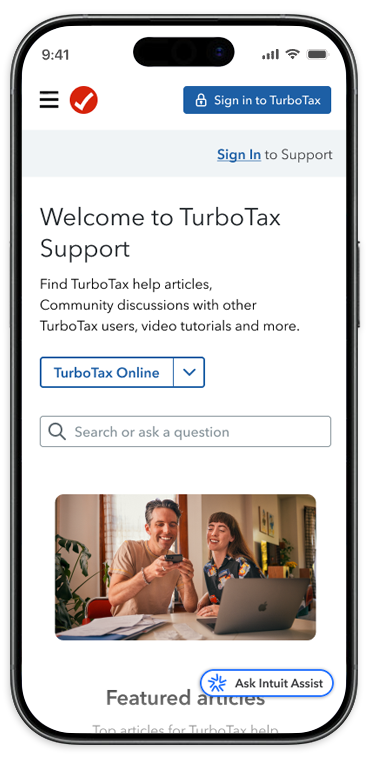
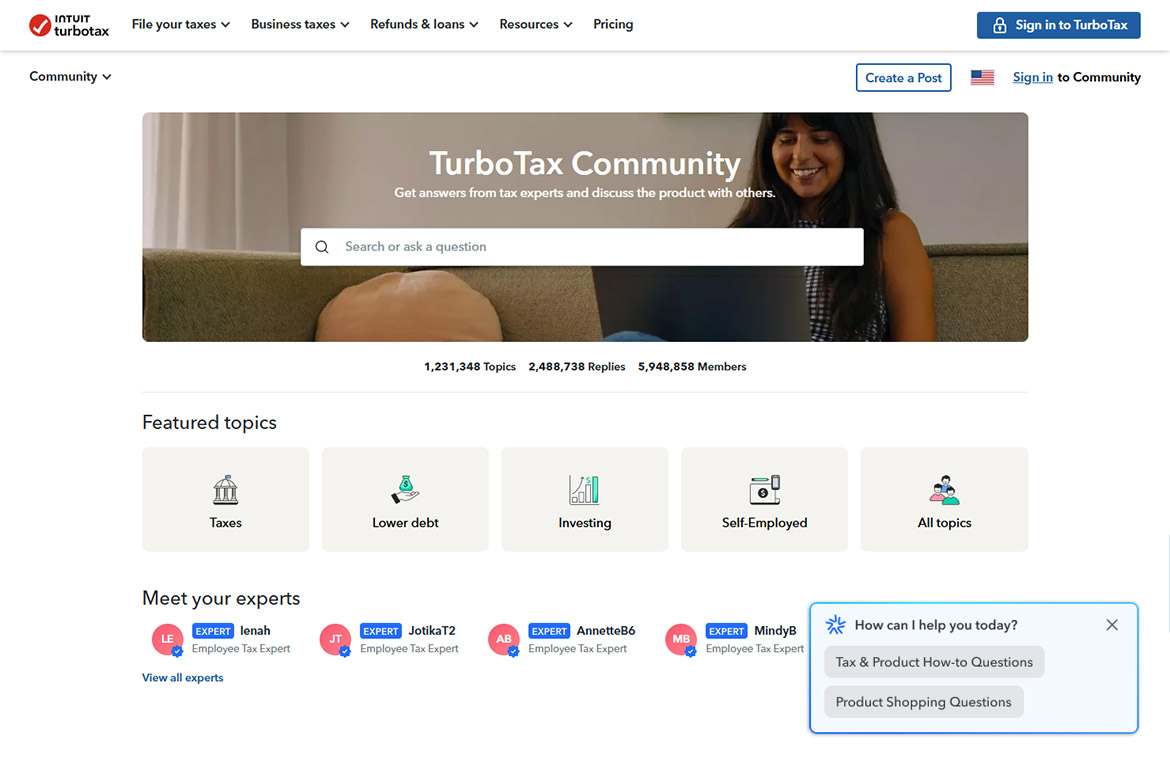
The first test introduced a floating action button, a persistent entry point that routed users to the right AI agent based on their intent. For the first time, both of TurboTax's conversational agents were reachable from the help surface.
The FAB test showed modest gains on Support but underperformed on Community, where 2.2 million visitors over two weeks generated fewer product starts and authenticated logins than the control.
Traffic to Start
98
Index to control
The failure was the finding. A floating button asks users to discover a new UI. On Community, where people arrive with a question already in mind, that friction was too much. The data confirmed what we suspected:
The AI entry point needed to meet users
where they already were.
Test Two
Search as the entry point
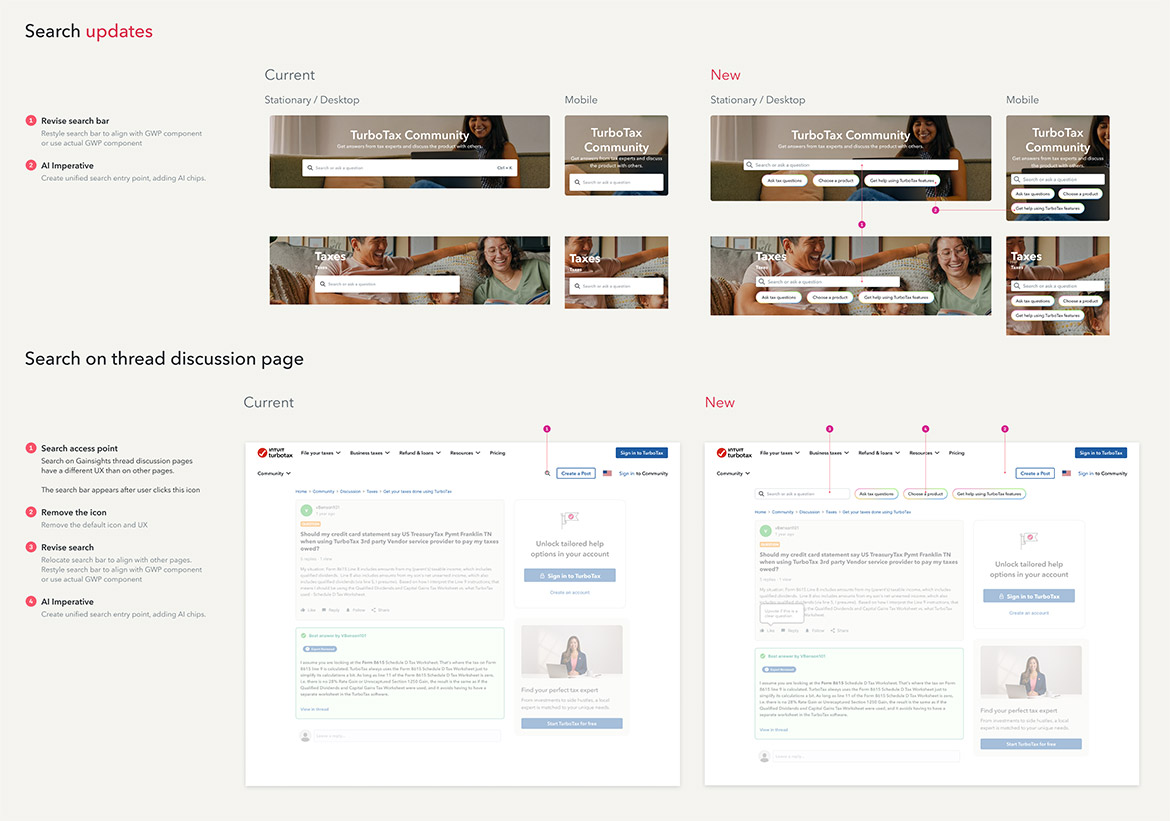
Research showed users already go to the search bar when they need help. They didn't need a new button; they needed the search bar itself to become AI-powered.
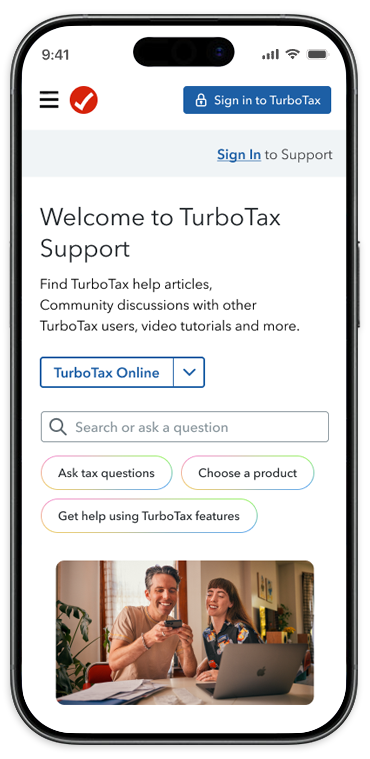
I designed suggested-prompt chips that appeared directly alongside the search bar: visually subordinate, but immediately actionable. The interaction model was familiar. The capability behind it was new. The experience began the moment a user engaged with search, no discovery required.
This also matched what users had come to expect. AI-powered search was already the norm elsewhere. A static results list felt like a step backward. The second test closed that gap.
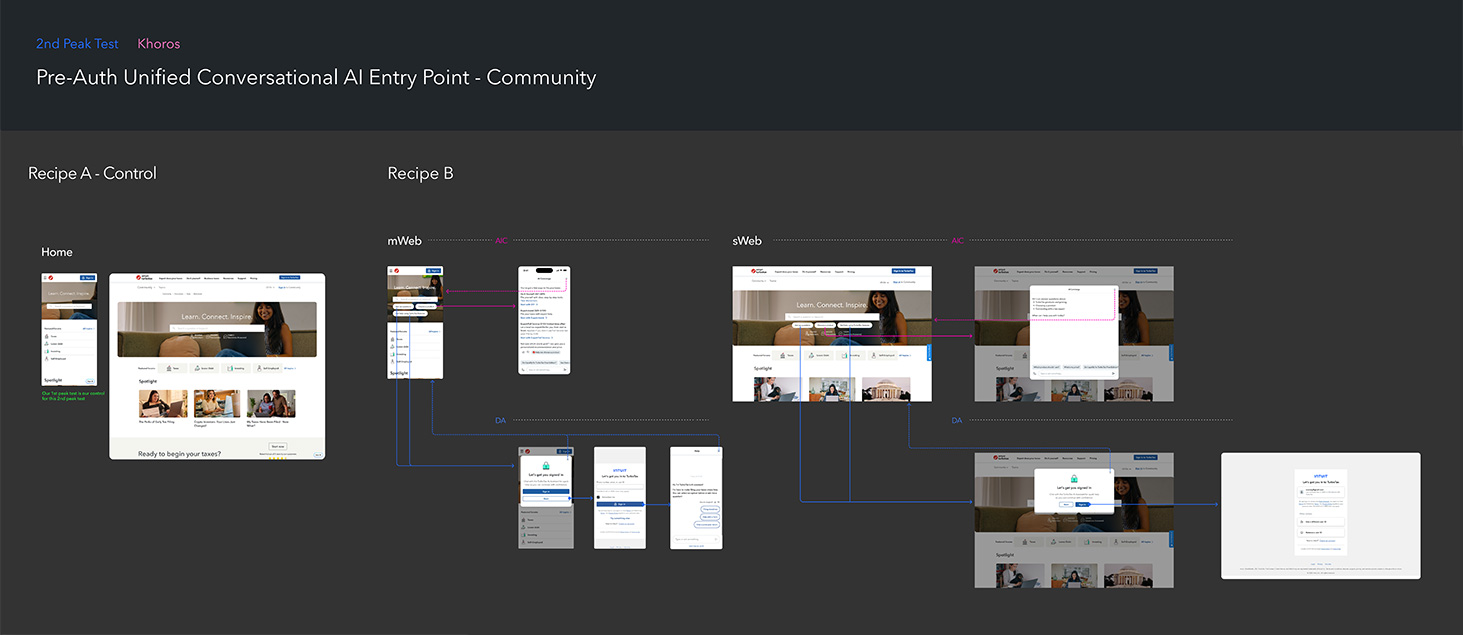
Two agents, one experience
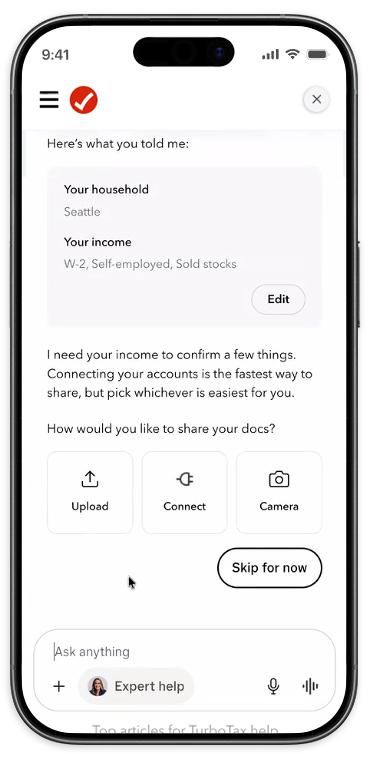
Behind the entry point, two distinct AI agents handled different user needs. Users asking about TurboTax's products, features, or pricing were routed to a pre-login agent, no account required. Users with questions about their specific tax situation were routed to an agent that required sign-in but could provide advice tailored to them. An orchestration layer reads each query and automatically makes the routing decision.
The design challenge was creating a seamless transition between agents and, when necessary, between authenticated and unauthenticated states, so the experience felt continuous rather than fragmented.
Getting the chips right
To define the visual design of the prompt chips, I collaborated with the team of designers dedicated to TurboTax's AI chat interface. Together we developed three distinct treatments, each exploring different combinations of iconography and border styling, and tested them rapidly across internal Intuit employees and public users via the Community portal. The winning design went directly into the second test.
4.6
Clarity rating
3.8
Clarity rating
3.2
Clarity rating
Results & Impact
Unified Search was declared a winner on product starts and revenue per visitor, 4% above prior-year benchmarks on both the Support Site and Community. It was scaled to 100% of traffic on both platforms.
The two-week test window reached 457,000 visitors on Support and 4.3 million on Community, more than double the first test's exposure on each platform. Across both tests, the work touched nearly 7 million visits.
The launch also delivered TurboTax's first pre-login agentic AI shopping experience: users could ask questions, get personalized product recommendations, and receive price estimates before signing in, a capability that hadn't existed before this project.
+4%
Product starts,
both platforms
+4%
Revenue per visitor,
both platforms
7
Million visitors
across both tests
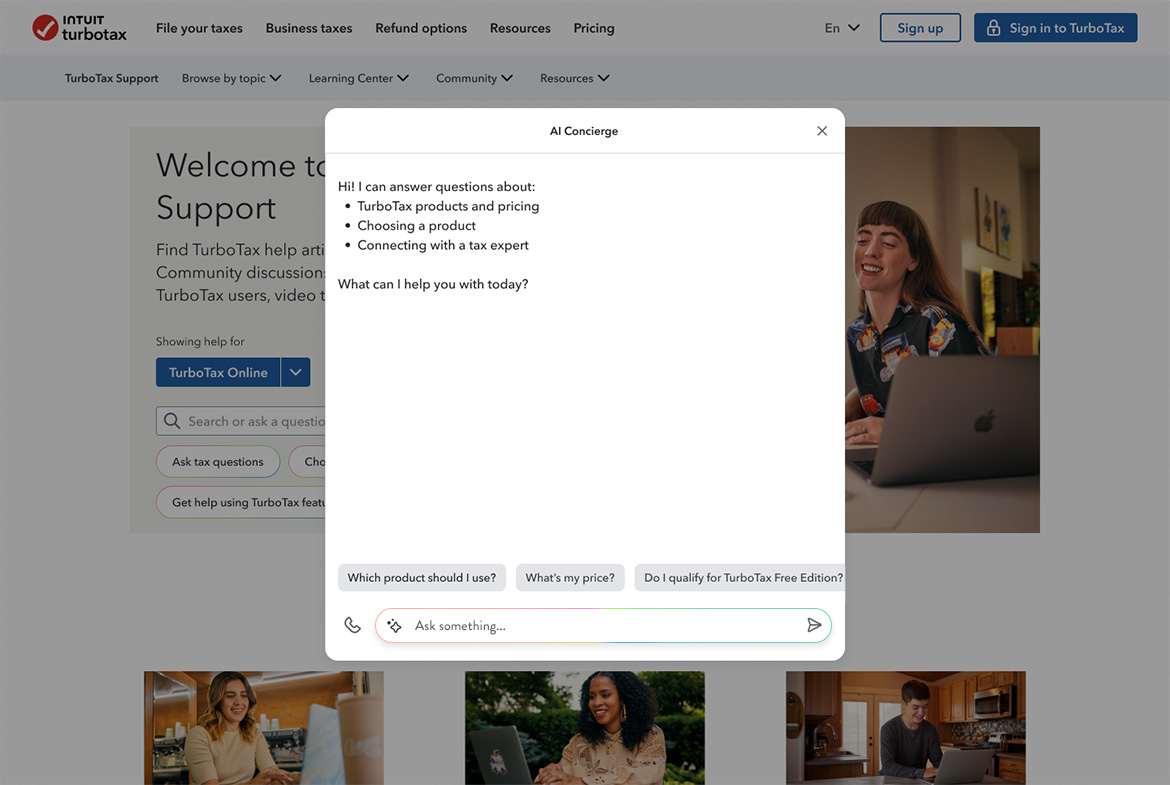
Pre-Auth AI Concierge modal
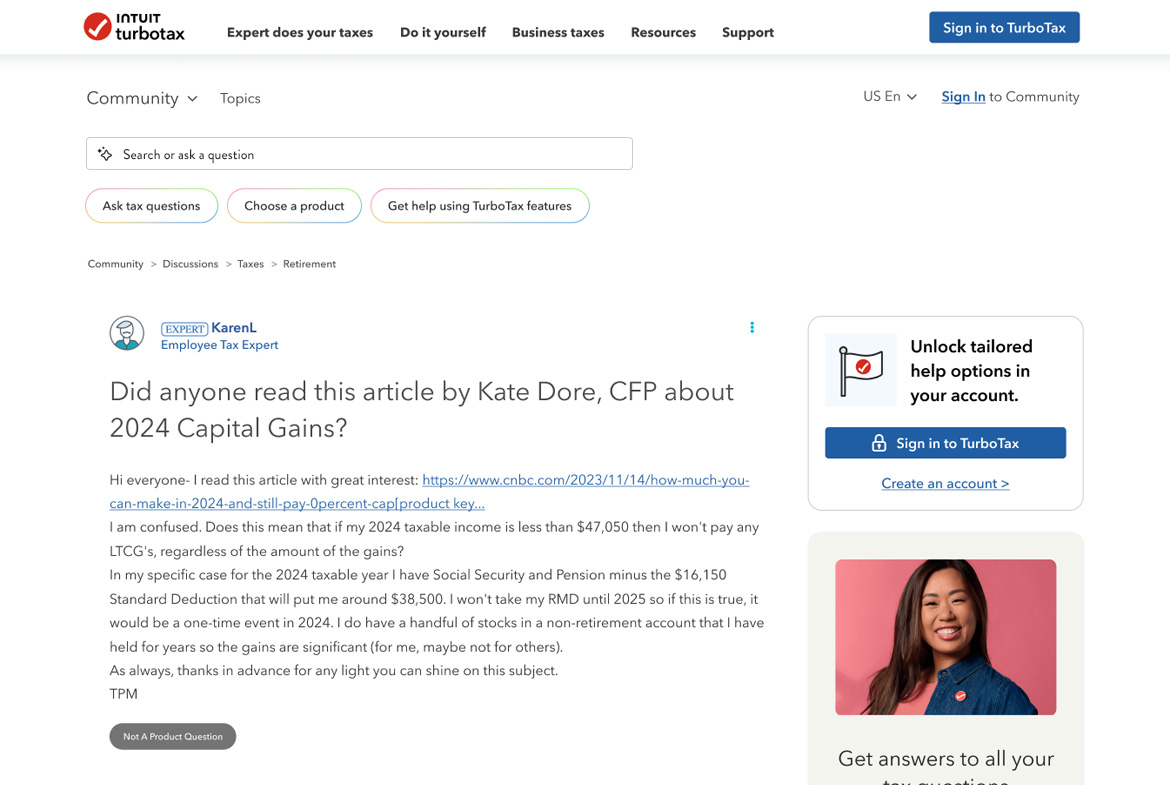
AI access across all community threads
